
ResearchTools
An AI-assisted toolbox for researcher-professors and graduate students. It finds and fixes what's wrong before a reviewer, a thesis committee, or a grant panel does.
📚 Academic writing
Literature reviews, paper and thesis audits, BibTeX cleanup, reviewer responses, submission
packages — a ScholarEval score before the reviewer ever sees it. The figures of a paper or a
thesis (TikZ, draw.io, SVG, bitmap) are reviewed with one shared figure-review skill, and
/work-ugs-audit grades a folder of undergraduate PDF reports against your rubric with local
models only, so a confidential report never reaches a cloud model.
🛠️ Software review, hardware to come
Code design with a bounded review loop, and the rt-observe dashboard to watch the agents work
and log what they did - and to ask it a question out loud: hold P, and a local model answers
from the toolkit's own memory, spoken back, nothing leaving the machine. The PCB and 3D CAD
chapters are placeholders.
⚙️ Local-model dev loop
local-writer / local-coder push routine generation to a local Ollama model instead of the
cloud — a design/plan/code/review loop that keeps token cost down. Which model fits your GPU is
measured, not guessed: opt-local-vram-llm tunes the LLM, opt-local-stt-vram scores
speech-to-text models beside it.
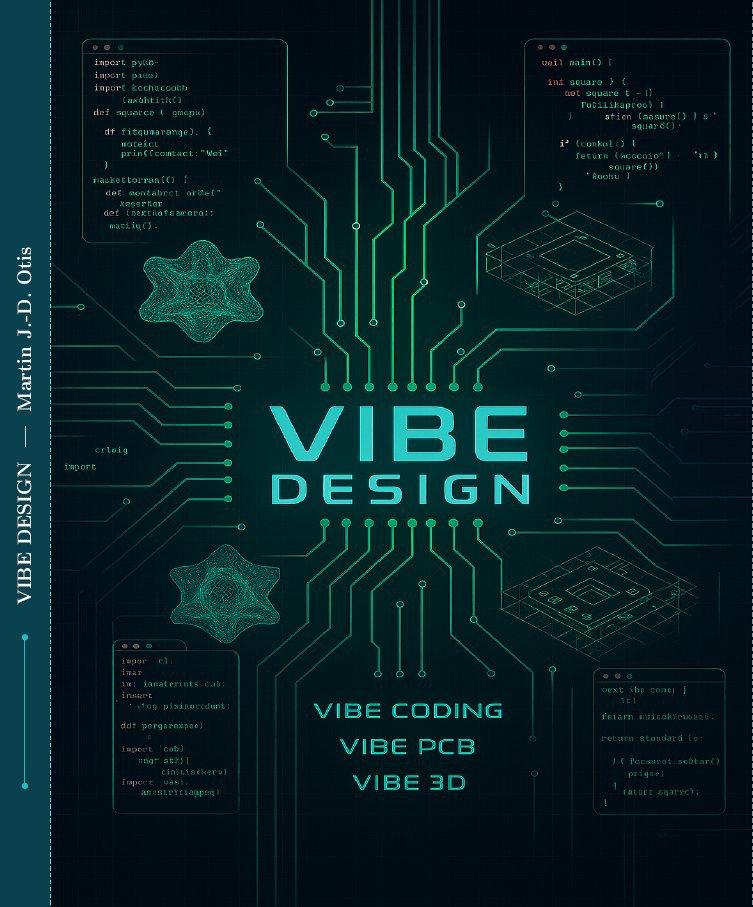
The book: Vibe Design
Vibe Design, by Martin J.-D. Otis (in French). Vibe coding, vibe PCB, vibe 3D: a new way of designing complete systems, in which the engineer works in dialogue with coding agents.
Why ResearchTools
| Without | With ResearchTools |
|---|---|
| Catch a missing reference or a broken hypothesis flow after the reviewer does | An auditor scores the manuscript first, against the same ScholarEval rubric a committee uses |
| Re-read a cited paper's abstract and hope the citation says what you think it says | extract-contributions checks the citing sentence against the paper's own stated contribution |
| Receive a thesis, an article or a talk as a PDF with no LaTeX source and re-type it before it can be audited | pdf2md converts it with mineru to markdown (the UQAC thesis layout, or one document for an article or a talk) and measures what the conversion lost against a second reader of the PDF |
| Burn cloud tokens on routine docstrings and refactors | local-writer / local-coder push that generation to a local model, for free |
| Guess which local model fits your GPU | opt-local-vram-llm and opt-local-stt-vram measure it on the card, beside what already runs there, and print one table to choose from |
This page is the homepage of the themed MkDocs Material site (mkdocs.yml at the repo root,
brand palette in assets/extra.css — navy #10243E, teal #1F9E8F, amber
#C9762F, taken from the project's own design system in post-media/Series Template.dc.html).
Nothing here duplicates the manual; every link points at the same file a Claude Code session
or a plain GitHub browse would read.
Preview locally: .venv-docs\Scripts\python.exe -m mkdocs serve (the environment comes from
.\setup.ps1 -InstallPython), then open the printed http://127.0.0.1:8000.
Publish: mkdocs gh-deploy, run by hand whenever the docs change — no GitHub Actions
workflow, matching this repo's no-CI/CD policy — then enable Settings → Pages → Deploy from
a branch → gh-pages. Links that reach outside docs/ (to README.md, Architecture.md,
.claude/CLAUDE.md) stay relative in the Markdown, so they work on GitHub and in the editor.
MkDocs only serves docs/, so the build hook scripts/docs/mkdocs_hooks.py sends each such
link to its page on GitHub (blob or tree on the branch named by extra.docs_source_ref in
mkdocs.yml, currently main), which means those links only resolve once the change is on
that branch. Heading ids use GitHub's slug algorithm (toc.slugify in mkdocs.yml), so the
double-dash anchors of 06-skills.md jump correctly (a repeated heading still gets MkDocs's _1
suffix where GitHub writes -1). mkdocs build --strict is clean, and
fails on a dead link or a dead anchor.
Start here
The manual lives in manual/, one chapter per topic:
Deep-dive references
Longer, single-topic documents that a manual chapter points into rather than repeats:
- aider-setup.md — the aider nightly pipeline, full manual
- rt-observe.md — the toolkit-state dashboard, full reference
- authoring-and-mirrors.md — adding or editing an agent, skill, or command, and regenerating the per-tool mirrors
- contributor-notes.md — shared conventions (English-only definition files, agent/skill layout, local-model routing, git/GitHub workflow)
- github-repo-setup-playbook.md — portable step-by-step for bringing another repo's GitHub presentation up to this same standard (README structure, doc-site setup, community files, repo settings, Issue/board/PR process rules), written for a Claude Code session to execute, not for a human to read once
Elsewhere in the repository
- ../README.md — repository root entry point
- ../Architecture.md — this repository's own 7-layer component architecture
- ../NEW_ARCHITECTURE.md — the architecture shared with the sibling repository ThesisTracker
- ../CONTRIBUTING.md · ../CODE_OF_CONDUCT.md